http://www.youtube.com/watch?v=i8LO-PEXMeM&feature=related
How does one insert a youtube clip into a blog?
Most evenings I sit around fighting the desire to be exceptionally drunk; to make the world a swirl of random sounds and images washing in and out of awareness. I crave the embrace of the drink descending, flooding my brain, compensating for the lack of meaning in ordinary consciousness, substituting the ennui with a synthetic soup of contentedness.
Most evenings, I win the fight. I manage to distract myself with piano, or a friend visits, or I have something important the next day that dissuades me from opening the wine. It is always the memory of my memory that makes the strongest argument from getting on the razz however. The drunken brain remembers everything - sentimentally. Things that you've long put behind you come back and are suddenly meaningful again. And you feel them. And life has been nothing but unfair to you. The bottle doesn't resolve anything. As Jay Farrar said "alcohol doesn't have much that matters to say." All you have the next day is a hangover.
The highlight of the last fortnight was "teacher reorientation camp." All of the renewing suckers except for the ones who'd wormed their way out of it were sent to "Hanhwa Resort" in Yangpyeong for 3 days of lectures on how to be a more effective teacher. HOT AIR!!! I did enjoy the noraebang (karaoke) however and ended up being glad that I hadn't wormed my way out of the camp. I met some loverly new friends and even though they mostly had boyfriends I will probably talk to them again if I am in a decent enough mood and if the wind is blowing in the right direction.
Wednesday, June 29, 2011

Saturday, June 11, 2011
Back In The Room
Folks, I'm back in the present. I'm no longer writing on something that happened months ago, which I only remember parts of anyway.
I have just crested what I consider to be the peak of March Semester 2011 at Imae Elementary. There was a steady build up of nerves to yesterday's "open class" - where teachers from around the area are invited to come and scrutinise our teaching practices during a class chosen by me and Kyung Hee back at the beginning of term. At that time we all agreed that 6-4 had the greatest skill with English, the most desire to speak English in class, and the best behaviour of the grade. So we chose them and locked it into the program, only to spend the next 3 and a half months watching them transform into one of the worst classes on my roster. Such is my influence.
All was well yesterday however. Although no teachers from outside Imae made the arduous 5 minute journey by air conditioned subway car to our school, we did play host to a couple of teachers within the school itself. I derived some satisfaction from having them see that it's me that carries the class and that my co-teacher is essentially, undeserving of the term.
Kyung Hee's "conduct" in the classroom has been a thorn in my side since the term began. It seems that she thinks her role as a co-teacher is to turn up to class and attempt to gain popularity with students. She has little regard for classroom technique, or even for the progress of her students (or lack thereof). She wants, as she explicitly told me after one class a few weeks ago, to be friends with the students. Was this clumsy English? I hoped so. What 50 year old woman wants 6th Graders for friends? I felt she was forgetting her primary role at the school is as a teacher, and also that I would face an increasingly hopeless situation as the year progressed (which seems to happen anyway).
How do you tell someone 20 years your senior how to behave? Tactfully, I think. I began by good humouredly saying I'm not much interested in winning their friendship and requested that she refrain from practices like having private conversations with the kids while I'm attempting to give them instructions. And that I'd also appreciate more support with helping maintain class order. So, she became overzealous in the next class and berated kids for laughing too loudly.
Our partnership is a work in progress. She's otherwise a very optimistic person (the kind that is unwilling to look facts in the face) and wears a carefree attitude (except when the authorities are around, when she shits herself) so I don't much want to be the person that brings her down with my attention to "rules" and "obligations." All changes will be implemented slowly and gently. She clearly tried after that first chat of ours after all. You can't expect to change very much in Korea anyway, and I feel that for your own sake the best thing you can do is attend to your relationships. That would be the Korean view, I believe.
The principal stopped by in our staffroom to congratulate me on the open class by the way. Kyung Hee was shepherding her around, laughing at her jokes and otherwise flattering her like one under the bonds of servitude. As they entered the entire staff stood up. I remained seated, tapping away on Facebook and listening to The Smiths on my mp3 player. Through one earpiece. I was chewing on the other one. I generally don't like sticking out like dog's balls, as I do over here, but sometimes I don't mind it.

Recently I enjoyed a trip to Jeju Island, the moderately-sized "honeymoon isle" off the south coast of Korea. This shot was taken at Andeok Valley, possibly the most peaceful locale in Korea I've yet experienced.

My travel buddy was Victoria, an American lassie teaching English in Busan. We actually met in Beijing at the Chinese Box Hostel. Here, we're enjoying a picnic of gimbap on one of the "black sand" beaches in Jeju. Tori, having lived in Hawaii for a year, assured me it was nothing like the real thing. In her hair she's wearing a mugunghwa - the national flower of Korea.

Lianne and I recently took a tour with the USO (social wing of the American military) to view the DeMilitarizedZone (DMZ). This picture is a panorama of the Joint Security Area where north and south face off against each other. It is the exception to the rule in the DMZ as the rest of it is in fact an area 4km in width. In the middle of this no-man's land, white markers stretch across the Korean peninsula and represent the location of the last hostilities at the signing of the armistice in 1953. The tension is real in this place. When I crossed into North Korea within the UN conference building which straddles the border, our U.S. military guide stated that we needed our passports to return back into the southern side of the room, and hence the free world. His delivery was terrific, and realising that my passport was in the tour bus, my stomach lurched before realising it was a joke they play on every tour. Well played, Private Vang, you utter bastard.

This is the gang whose company I value so much. The night after our DMZ tour, we rented a "pension" in the east of Seoul in some very nice countryside, took provisions of steak, wine and mozzie repellent, and sat around the barbie telling stories about stuff. From right to left is me, then Lianne, then Michael, then Yuta. I don't have much in common with the majority of the foreigners over here, but this lot, they're pure quality.
I have just crested what I consider to be the peak of March Semester 2011 at Imae Elementary. There was a steady build up of nerves to yesterday's "open class" - where teachers from around the area are invited to come and scrutinise our teaching practices during a class chosen by me and Kyung Hee back at the beginning of term. At that time we all agreed that 6-4 had the greatest skill with English, the most desire to speak English in class, and the best behaviour of the grade. So we chose them and locked it into the program, only to spend the next 3 and a half months watching them transform into one of the worst classes on my roster. Such is my influence.
All was well yesterday however. Although no teachers from outside Imae made the arduous 5 minute journey by air conditioned subway car to our school, we did play host to a couple of teachers within the school itself. I derived some satisfaction from having them see that it's me that carries the class and that my co-teacher is essentially, undeserving of the term.
Kyung Hee's "conduct" in the classroom has been a thorn in my side since the term began. It seems that she thinks her role as a co-teacher is to turn up to class and attempt to gain popularity with students. She has little regard for classroom technique, or even for the progress of her students (or lack thereof). She wants, as she explicitly told me after one class a few weeks ago, to be friends with the students. Was this clumsy English? I hoped so. What 50 year old woman wants 6th Graders for friends? I felt she was forgetting her primary role at the school is as a teacher, and also that I would face an increasingly hopeless situation as the year progressed (which seems to happen anyway).
How do you tell someone 20 years your senior how to behave? Tactfully, I think. I began by good humouredly saying I'm not much interested in winning their friendship and requested that she refrain from practices like having private conversations with the kids while I'm attempting to give them instructions. And that I'd also appreciate more support with helping maintain class order. So, she became overzealous in the next class and berated kids for laughing too loudly.
Our partnership is a work in progress. She's otherwise a very optimistic person (the kind that is unwilling to look facts in the face) and wears a carefree attitude (except when the authorities are around, when she shits herself) so I don't much want to be the person that brings her down with my attention to "rules" and "obligations." All changes will be implemented slowly and gently. She clearly tried after that first chat of ours after all. You can't expect to change very much in Korea anyway, and I feel that for your own sake the best thing you can do is attend to your relationships. That would be the Korean view, I believe.
The principal stopped by in our staffroom to congratulate me on the open class by the way. Kyung Hee was shepherding her around, laughing at her jokes and otherwise flattering her like one under the bonds of servitude. As they entered the entire staff stood up. I remained seated, tapping away on Facebook and listening to The Smiths on my mp3 player. Through one earpiece. I was chewing on the other one. I generally don't like sticking out like dog's balls, as I do over here, but sometimes I don't mind it.

Recently I enjoyed a trip to Jeju Island, the moderately-sized "honeymoon isle" off the south coast of Korea. This shot was taken at Andeok Valley, possibly the most peaceful locale in Korea I've yet experienced.

My travel buddy was Victoria, an American lassie teaching English in Busan. We actually met in Beijing at the Chinese Box Hostel. Here, we're enjoying a picnic of gimbap on one of the "black sand" beaches in Jeju. Tori, having lived in Hawaii for a year, assured me it was nothing like the real thing. In her hair she's wearing a mugunghwa - the national flower of Korea.
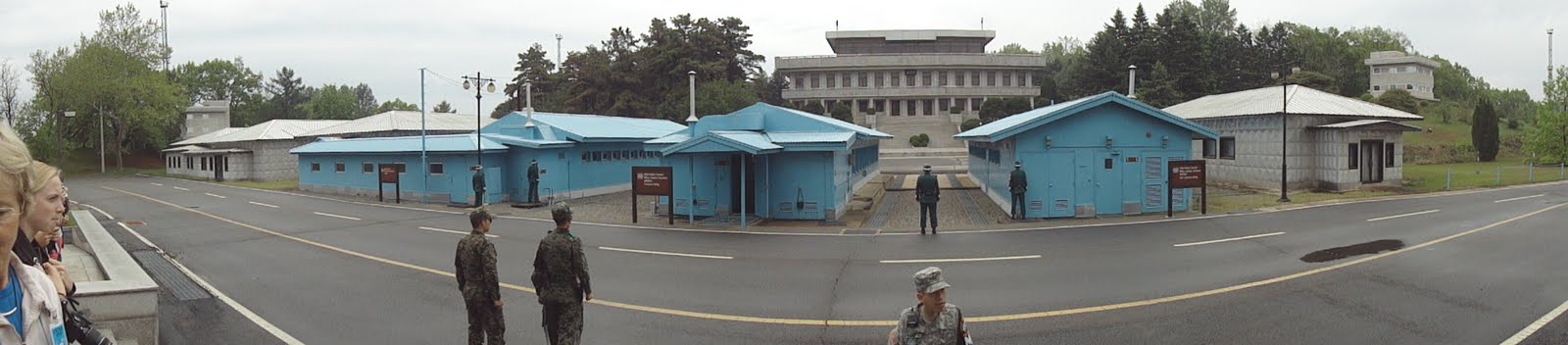
Lianne and I recently took a tour with the USO (social wing of the American military) to view the DeMilitarizedZone (DMZ). This picture is a panorama of the Joint Security Area where north and south face off against each other. It is the exception to the rule in the DMZ as the rest of it is in fact an area 4km in width. In the middle of this no-man's land, white markers stretch across the Korean peninsula and represent the location of the last hostilities at the signing of the armistice in 1953. The tension is real in this place. When I crossed into North Korea within the UN conference building which straddles the border, our U.S. military guide stated that we needed our passports to return back into the southern side of the room, and hence the free world. His delivery was terrific, and realising that my passport was in the tour bus, my stomach lurched before realising it was a joke they play on every tour. Well played, Private Vang, you utter bastard.

This is the gang whose company I value so much. The night after our DMZ tour, we rented a "pension" in the east of Seoul in some very nice countryside, took provisions of steak, wine and mozzie repellent, and sat around the barbie telling stories about stuff. From right to left is me, then Lianne, then Michael, then Yuta. I don't have much in common with the majority of the foreigners over here, but this lot, they're pure quality.
Tuesday, May 24, 2011
China Part 7
Readers, this has been bothering me for some time. Too many people start blogs only to watch their enthusiasm peter out within a few months. I didn't want to become another statistic of cyberspace. Life has gone on and I continue to accrue new Korean experiences. Much of it is worth writing about, but I can't settle until I wrap up my middle kingdom adventures with a few anecdotes and a few more pictures. So here it is. China Part 7.
Beijing McDonalds was a welcome sight. A few years ago some bonehead decided to remove the dining cars of all overnight trains in China and replace it with someone wheeling a cart up and down the carriages, charging unreasonably high prices for instant noodles. No thankyou. I'm going for a Sausage & Egg McMuffin TM first thing tomorrow. Mmm-hmm.
The Chinese Box Courtyard Hostel run by Joe Leoson near Xisi subway station was one of the best finds of the whole trip. Calm, peaceful, relaxing, warm, soothing, and did I mention peaceful? I had originally planned on spending 6 nights in the capital before heading north again, this time to Harbin, but upon hearing from some travellers in Xian who had just been there, I decided I could see it another time. The temperature was frequently as low as minus 25 and the services were far less reliable than Xian or certainly Beijing.
Added to that, I was exhausted. Much of the purpose of the trip was to have that backpacking adventure that I never had when I was younger. It turns out, I'm not much into it. I'd like to go back to China one day, but I'll be much more careful about my schedule next time around. China is draining and it takes a lot of energy to tackle it successfully. So I enquired as to whether or not I could stay in Beijing for 10 nights instead of the original 6 I'd planned. They were already booked around the new year, but Joe invited me to his new hostel - the "Chinese Box Great Wall Hostel" - situated in the village of Gubeikou right underneath, you guessed it, the Great Wall of China. Sounded like a good compromise to me.

I did a lot of photowhoring the day I went with a tour group to the Jinshanling section of the Great Wall, but nothing beats getting a Mongolian t-shirt vendor to click the shutter for you. It was 5 kms up and 5 kms back at Jinshanling, and I knew that I didn't want anything from her, but she followed me the whole way, and in the end I broke into a trot to get rid of her. The Great Wall was once built to keep Mongolians out, now it's their workplace!
The following day I went into Tiananmen Square at about midday, which is also when Mao's mausoleum closes. I'll have to go back for the Chairman's formaldehyde-ridden corpse another time. Or not. I've had it with these North Asian dictators in fact. Once a good opportunity for ironic laughs on animated TV programs, they can now all go and get fucked. All the lies, the hypocrisy, the bullshit: they are worse than our leaders in the West. At least we tolerate opposition. At least the vast majority of us don't live in fear or poverty or in a preventable famine. Yes, Jong-Il, I'm pointing at you, you fat piece of shit.

The author fulfills his lifelong dream of visiting one of the focal points of our glorious Chinese Communism, where 21 years ago the brave soldiers of the People's Army repelled scores of vicious pen-wielding student protesters who were calling for such bourgeois and counter revolutionary things as democratic elections and a free press.

From Jingshan Park (which was made from the soil that workers dug the moat of the Forbidden City from) I looked over the Forbidden City. The flat landscape of Beijing means you can see a lot from here (and also makes cycling relatively easy).


I went on another tour, this time to the Peking Opera. I loved it. Subtitles helped a largely foreign audience. Stagehands to our right having an unbelievably loud conversation hindered them. Nevermind. No one else really liked it, but I did. It touched me. I went for dinner after with the Germans I met on the tour. China attracts a true cross-section of the world's travellers, and not just 25 year olds screaming "that's what she said" at you and high-fiving each other while they drink so much that they puke in your mama's mouth. Ah-sum.

Not bad eh? This is the vista we enjoyed after climbing for about 2 hours at Gubeikou. The wall here was 500 years old in parts and 1500 in others!
So there it is. The overnight train to Dalian from Beijing was a bad idea. The man opposite me kept me and his family up all night with his non-stop snoring, farting, and sleep-talking, interspersed with these weird sigh-like exhalations. That night I turned Kate Bush up so loud that if there had been a garage door on the train it would have opened and closed all night. Hounds of Love is one of the finest records I've heard. You should get your hands on it and feel something new today. God knows, that's exactly what I need.
Saturday, April 9, 2011
China Part 6
Readers, I haven't posted in so long because daily life has become so busy. I like it. Sudddenly I have a reasonably interesting job where my native-speaking abilities are actually called upon (sometimes more than once in an afternoon). Imae Elementary School is no longer content in paying me to sit on the 5th floor (I call it the attic) and watch videos on youtube each afternoon.
Work has become something I more or less look forward to. There are now 8 people in my staffroom, 6 of whom speak the English. The other 2 are nice people. The remainder of the staff have also been far more welcoming towards me this year. I teach Grades 1 and 2 now, and so see another 8 teachers on a weekly basis. About 7 teachers left our school at the end of February and were replaced by newcomers. Almost everyone except for Byeong-Chan (aka "Grandpa Teacher") has a different role this year. It also seems that all the kids say hello to me now. The atmosphere has undoubtedly changed for the better. I've signed on for another year. And I get a pay rise on top of all that.
My China posting was moving along at a snail's pace and then stopped completely. I wanted to document it in detail but the school schedule wasn't allowing for that. Here, I'll try to finish my trip in one final blog, taking in Xian, Beijing, and the Great Wall Hostel at Gubeikou.
On our final night in Shanghai, Michelle and I arranged to go and see some acrobats. Unfortunately photography was not allowed so I couldn't document it. Their feats of strength and flexibility were enough to leave me with the determination to never abuse my body in any way ever again, a determination which lasted a whopping 3 days. I took a flight to Xian as train tickets were fully booked. The idea was to take the train and watch the landscape change over a lazy 18 hours out to Shaanxi province. By air, it was just as interesting: we took off from the metropolis of Shanghai and a vision of neon, wealth and decadence and pierced through the clouds. 2 hours later, coming down again, we were back in the 3rd world, flying over farms, the dusty and flat earth divided up into its allotments, soviet era trucks belching black smoke into the air.
After taking the airport "express" into the centre of Xian (at one point the driver stopped, got out of the bus and disappeared from sight, not reappearing for 10 minutes) I set off for my new digs near the south gate of the old city. The Shuyuan was a really impressive old courtyard residence and the staff were terrific; unfortunately it was a "party hostel" so every morning at 4 we were woken by shouts of "OHMYGARD" and "WOT A FUCKIN BELL END MATE" and an assortment of other snippets of highly intelligent conversation.
Next day: the warriors. Here's a picture!

This is inside the main hangar (Pit 1) at "Bingmayong." The first warrior was discovered here by a farmer digging for a well in 1974. These days he's a minor celebrity and sits in the souvenir shop signing copies of his book all day. All up there are around 8000 clay warriors, though not all of them have been uncovered.
The next day I set out to cycle around the city walls. It was hard work and pretty boring at times, but also impressive to be on top of a Ming-dynasty structure. At some times on the trip I really wanted to be able to share the moment with someone and this was one of them. It didn't help that couple after couple cycled past me on those tandem bicycles, mostly travelling in the opposite direction!

Lonely? Me?
Before I left Xian I took a lesson in how to cross a Chinese road. First, you wait for other pedesrians to arrive in order to go for safety in numbers. Then, when there are enough of you, stick to them like glue, crossing one lane of traffic at a time in an unspoken pedestrians' agreement. Keep your body square on to the lines of cars, trucks, buses and bicycles coming at you. Midway on your journey you will be in the middle of 6 lanes of traffic and trying to avoid being collected by several vehicles at once, but it is a metaphor for life in many ways: only those who persevere do not end up flattened by the 310 bus to the Drum Tower. When and if you reach the other side you may feel the desire to hug your fellow travellers in the way survivors of an air disaster often express spontaneous emotion. If you are comfortable with this, let yourself do it. They will probably be puzzled or maybe amused at your behaviour.
An excerpt from my diary, January 26, 2011:
"Here I am in the "soft seat waiting room," an absolutely brilliant find, because although it's almost filled to capacity with China's middle-class now, it's nothing compared to the carnage out there in proletarian-class. We think Central Station in Sydney is a dump, and when compared to the rest of the country it may well be, but the chaos of a Chinese railway station is about to most "3rd world" situation I have yet seen: the rush, the filth and confusion, the military and police everywhere, the shouting, people queueing but not quite, bag-checks, trying to determine what the characters mean, getting your ticket checked at least 3 times, worrying about whether or not you're in the right place, being pushed along all the time, being pushed if you stop to collect yourself. This may well be the evening where I begin to miss the familiarity of Korea and the comforts of my flat: guaranteed hot shower, near-guarantee on a good night's sleep, internet access, warmth."
Well there it is: the origins of my appreciation of Korea at Xian railway station. The journey from Xian to Beijing itself was really comfortable. Not many people travel into the big cities at that time of year (compared with the people coming out), so I shared the compartment just with one other middle aged bloke, who spoke English well and helped me find a few things the next day. For all of its chaos, you always meet kind people on your journey in China, and I arrived at the well-maintained and peaceful Chinese Box Courtyard Hostel with the sudden desire to stop moving around and just settle here for the remainder of my trip.
Well I didn't quite manage to finish the trip in this blog, but will get back to it ASAP. Hope you're all travelling well!
Monday, February 28, 2011
China Part 5
Readers, how I posted a blog about my time in Shanghai without including any of the lovely pictures I took of the Bund with my new camera, I don't know.


The "European shore" of the Huangpu River has buildings that date back to the late 19th century. This part of Shanghai was conceded to foreign powers after the Treaty of Nanking in 1842. Shortly afterwards, the traders moved in. These grand buildings all once served as banks, consulates, customs houses and clubs for the exceptionally wealthy. Many of them are now closed but are spectacularly lit up at night for the crowds of tourists wandering up and down the elevated river bank.

Zhongshan Road follows the curve of the river. This photo was taken close to the Meteorological Signal Tower looking north.

Here is the modern face of Shanghai. This, the far shore of the river at Liujiazui was nothing but rice paddies until very recently.

Broadway Mansions looms over the steel bridge which leads over Suzhou Creek and away from the centre of the action. Japanese military officials oversaw their occupation of Shanghai from the top floor of this building, which had previously been full of western journalists reporting home on the siege of the city. The Japanese used Shanghai as their starting point from which they then laid waste to the country all the way to Nanking, the Nationalist capital of China. When Nanking fell, the Nationalists under Chiang Kai-Shek moved to Chongqing, and eastern China was under Japanese dominion until their surrender in 1945.
I spent 3 nights in Shanghai, meeting Shanghai people and paying Shanghai prices, before taking a plane out to Xian due to the shortage of railway tickets. I'll pick up the story next time upon flying over third world farms and landing in the dusty ancient capital of China.
Tuesday, February 22, 2011
China Part 4
The train zipped through the Yangtze River delta to Shanghai. Our speed reached a top of 317 km/h. I watched the indicator at the head of the carriage like a man constantly obsessed with the speed and the direction of things. Occasionally I gazed out at length at one of the cradles of Chinese civilisation. It's developed from Nanjing all the way through to the coast. The greater Shanghai area is home to 27 million people. That's more people than live in my entire country.
A city of this size puts things in perspective. I will never think of Sydney in the same way again. As much as it was "the big smoke" for me, growing up in my town of 8000 professional drinkers and retired sporting heroes in country New South Wales, most of Sydney is characterised by suburbs and front lawns full of bindies and runners of kikuyu grass. To beat the heat of Summer we used to strip down to our cossies and dash through the garden sprinkler while clutching flavoured ice blocks, as did our city-based cousins.
Having a lawn in Shanghai probably means you are squatting in a heritage listed property. Europeans and Americans moved into Shanghai en masse around the turn of last century in the spirit of the same opportunism which had driven them to Asia and Africa throughout the previous 3 or 4 centuries. They took the best land and set up their trading empires, building vast mansions and enormous banks down by the Huangpu River.
There's a lot of activity in Shanghai. I got a feel for this the afternoon I rolled into town. Having learnt my lesson that it was prudent to secure an ongoing ticket immediately upon arriving in a new location, I emerged from the platform and set out to look for the "soft sleeper ticket office." Being the only caucasian and the only person with a backpack made me stand out like an original song on the pop charts. As did the fact that I was obviously unsure of where I was. I did see other caucasians later but they were wearing suits and had their eyes firmly focused on the horizon as they jostled through the crowds. Businessmen: it's all about outcomes.
A punter standing around having a post-lunch cigarette and spit with his mates saw this confusion and asked me where I was going. It was a normal enough question. "Xian," I said. He launched into action and made me a deal without me even knowing it. Seconds after it sank in that he was about to sell me a bus ticket to Xian for 600 RMB. I used the bustling crowd to lose him, put on my black beanie and did some urgent window shopping at Chinese tour booking office. When it was safe to move on, I continued up the street and saw him leading a group of confused travellers in the opposite direction.
It's probably a lucrative business, scamming confused newcomers. Even if 20 reject your deal outright and only 1 bites - and you mark everything up by a ludicrous amount - you're still breaking even wih the official competitors. It is said in the travel books how important "face" is in dealing with Asians and that you should never do anything that embarrasses them in public. This includes calling their bluff, so even if they suggest a price which is 8 times a reasonable amount, you should respond with "no that's too much, how about 1/16th of said amount?" I used this recommended approach for the first half of the trip but it felt fake. I felt I was betraying my Australian roots. By the time I reached Beijing I had reverted to the tried and true "you've gotta be joking mate." It felt great. I wish I'd taken my slouch hat.
I never found the soft sleeper ticket office, which was a shame because it sounded nice. I imagined plush velvet couches and waiters circulating with trays of hors d'eouvres. Instead I found the standard ticket office, which had become the home of about 2 million of those 27 million Shanghaiers I mentioned earlier. They were temporary residents trying to get tickets to their hometown for the Spring Festival. They moved in with their suitcases and cigarettes and mothers in law and stood around talking and eating sunflower seeds. Announcements blared the latest train to fill up and I suddenly thought of going to Kunming, 2 days away by train, but undoubtedly greener than these pastures. I found myself in a queue without quite being sure of how this even happened, and started rehearsing my Chinese. It came out with a pronounced stutter, but he understood me alright. "Meiyou," he said, twice, something I understood perfectly. It is the most favoured utterance of a Chinese ticket officer around Spring Festival, and sounds exactly like "mayo." I suddenly desired a chicko mayo sanger at Lake Alexandra punctuated by the popping of tennis balls on rackets at the nearby courts.
The English speaking window man informed me (I think) that there were no tickets available to Xian for the next 11 days. And none to Kunming within 6 days. Fine, looks like I was flying then. I reckoned that it was pointless to plan in too fine a detail your trip to China because things will change dramatically when you are on the ground. This is true of everywhere of course but I think China demands the flexibility of a gymnast whereas many other destinations probably only require a bit of yoga now and then before setting out. Are you with me?
I left and went to Subway, where the nametags of the sandwich artists read "oven" and "grill." Another customer spoke to me in perfect American English (I know what you're thinking and no that's not an oxymoron so don't even try and pull me up on that one - a lot of them are quite clever these days) and told me about her life as a children's talent scout in Shanghai. Clearly I wasn't in Suzhou anymore. She wore a little French beret and had crooked teeth like mine, if not so yellow. She finished up and wished me a good day and pleasant time in Shanghai and left. I let her go, then spent the rest of my time in Shanghai wishing I had made myself pretend to be more attracted to her. Are you with me?
Down at the hostel, a Chinese guy interrupted while I was checking in and the receptionist went and served him before me and I made up my mind that I didn't like the place. That perception didn't change over the 3 days I stayed there. Not only was the receptionist a complete and total dickhead but there were 2 guys dying in my dorm room, the elevator was broken, the drinks were 10 times as expensive as in Qingdao and my washing didn't dry in the 3 days I was there. I resolved to spent as much time out of the hostel as I could, threw down my bags and headed for the Bund.

The vista which welcomed me down at the Huangpu River: no less awesome because of the fogginess which obscured the tops of the buildings at Liujiazui. This area has become one of a few symbols of the economic boom China has witnessed over the last decade. It is said, that 10 years ago, this area was just rice paddies. Shanghai is the most "western" of Chinese cities. The entrepreneurial spirit of its people was downright irritating at times.
The next day I headed for the French concession, which was total bollocks. There's an area that's been rebuilt according to fulfill "standard European ambience," and which is full of shops selling designer label clothing which was truly a waste of time. Lonely Planet directed me to a cafe that doesn't exist, then the Sun Yatsen house, then the site of the founding of the Chinese Communist Party, both of which were full of overzealous security guards watching me as if I were trying to bring down their stupid government. Perhaps they thought epaulettes impressed me? I actually find them to be really camp. All I wanted was something decent to look at and a good chicken and mayonnaise sandwich.
But things became interesting later that night when I went into a Muslim-run restaurant for some of my favourite noodles. The Muslim part is incidental and not important to the story at all. I just want you to know how cosmopolitan and accepting of other cultures I am. A group of 3 Chinese in their early 20s watched me with curiosity, then moved to the seats opposite me once the existing customer had cleared out. We enjoyed some conversation, enough to break the ice of international friendship, along with the beer they plied me with. They then ordered liberally from the menu and invited me to join them. Then when we'd finished they paid for everything including the noodles I'd ordered to begin with. The negative thing about it however was in the hostile attitudes they showed towards the Koreans in the restaurant. I felt sorry for the weird and insular Koreans right then. Yes they are odd, group-oriented and socially backward, hard to befriend, suspicious of change, and utterly hopeless with English but I don't see why that should resulting in anyone actually disliking them. It would be far worse if they travelled to everyone corner of our beautiful world with a striking contempt for its diversity, or without a clue as to how things develop historically. Or, if they had the stated objective and the power to take as much as they could without consideration for others.
Tomorrow: a walking tour of the Bund and acrobats!
Saturday, February 19, 2011
China Part 3
17/1/11
Travelling south through Shandong and Jiangsu provinces. China in Winter: barren, polluted, dusty and dry. Went to Jinan first, in the west, before turning south to head to Nanjing. Highlights: some conversation with the guy next to me, who later politely corrected a few things; also listening to The Vines + Cut Copy as I travel through China.

The super fast Z93 express train that took me from Shandong to Nanjing in 8 hours. I'd heard horror stories about the discomfort of Chinese trains before I left Korea but wanted to try them nevertheless. I ended up making 3 long-distance railway journeys while in China as well as a couple of shorter ones around the Yangtze delta. The verdict? Chinese trains are fast, efficient, clean and punctual. The overnight sleepers I took also put paid to any stories I'd heard about the Chinese being unbearable travelling partners. True, purchasing the tickets can be a time-consuming and stressful experience, but once you are in your seat and watching the landscape zip by at up to 330 km/h, you'll inevitably ask yourself the question "why can't my country do this?"
At Qingdao Railway Station, I was tense. "Take a spare padlock," people had said. "Lock the zips of your backpack together." I sat in the soviet-inspired waiting room no. 4, complete with chandeliers, and flipped through my Mandarin phrasebook while waiting for the boarding call for the 10:30am Z93 bound for Shanghai. "Don't stick out too much," I told myself. "Don't look like a traveller. Don't stand up. Also, that black beanie ain't fooling anyone."
A group of boys in their early 20s constantly looked over and made comments to each other, then one of them looked as if he were selected and would advance toward me before losing his nerve and returning to the group. "Here it is; watch your things," I told myself. My paranoia toward these young chaps was mounting so much that I'd discounted friendly interaction with anyone else. So when a different young bloke approached me from the other side, just wanting to chew the fat before we boarded the train, I met his friendly "Hello, do you mind if I sit here?" with "Who are they?" gesturing at the first group. He shrugged and commenced his repertoire of questions for foreign travellers:
1 Where you from?
2 How old are you?
3 You married?
4 Why not?
5 Why you travel alone?
6 You no get lonely?
How can I? People interrupt me from my Lonely Planet Mandarin Phrasebook everywhere in order to ask these questions. I'm thinking of getting my responses laminated on a card and hanging it around my neck:
1 A small town near Sydn... oh, never mind - Australia, the kangaroo place
2 30
3 No
4 Women don't like me very much
5 We're in Asia champ, there is no such thing as "alone"
6 Yes but your women are quite affordable
He was a nice young bloke with decent English. Still, he got nothing from me but the prickliness of a paranoid Australian traveller who'd finally gotten around to reading his copy of the government's smarttraveller brochure. I was suitably humbled when, shortly before boarding the train, he moved away and sat alone with his suitcases.
On the train I'd loosened up and was chatting with the young engineer from Wuhan beside me. "How old are you? Where are you from? Are you married?" I asked him. Perfectly normal questions for someone wanting to know a little more about someone.
"Do you want some bread?" Please say yes. I'd been curious about this stuff called mantou, a flavourless, cheap but very filling Chinese bread often found at street markets, and so had bought some on the way to the station. Despite purchasing the smallest bag I could find, it was clear I'd need a family to help me finish the stuff. Two huge domes of scarcely-baked dough stared out at me from the clear plastic bag like a massive pair of nipple-less mammaries on one of those fetish websites that I never look at. Now that you've spilt your cup noodles all over the carriage you must take some, surely. He didn't. Saving face? Maybe I wasn't insistent enough. I'm not very good at that. If someone says "no," I usually assume they mean "no," but that's the way I was raised. Not all cultures have the same behavioural protocol. We reached Nanjing and he took me to the subway. More random kindness. The Chinese were growing on me.
Finding the hostel would have been so simple if I'd just followed the directions that I'd copied down from the hostel website. Instead, at Sanshanjie St exit 4, the uncertainty set in. "Maybe that's the big streetsign? I'd better check what's up at the intersection. Oh there's a canal down there. That might be the canal that the directions referred to. Lemme just check the map. Yeah, that's where I am now, so if I follow this street I'll be there in 10 minutes." Of course, I was walking in the opposite direction. I then walked in the right direction for a half an hour and even peered in the window of the hostel as the ground floor was a bookshop/cafe before moving on and asking for directions from the rival hostel, which I'd found first. I then left that hostel, thankyou thankyou, and, in an unnecessary anxious hurry, plowed into a young Chinese girl. More apologies. I feel stupid and I hate Nanjing. I checked in and Michelle walked past my dormitory door. We went sight-seeing and I forgot everything.

The Fuzi Temple area of Nanjing at night is much neon, waterway, and tourists saying things like "can you take a picture of me in front of the neon dragon and waterway?"
The next day, a comfortable and very fast train whizzed us through the Yangtze delta area from Nanjing to the canal city of Suzhou. This city is popular with Chinese tourists for having preserved the ancient waterways which once would have (how's that for alliteration?) transported goods and important people back and forth. Suzhou is known for its beauty and in the softly falling snow of mid January it was indeed a beautiful sight. The Chinese have a saying that goes something like "in the sky there is heaven, on earth there is Suzhou" as a paean to the wonders of this "town" (population 6 million).


The canals of Suzhou by day and by night. The street our hostel was on was mercifully closed to anything but pedestrian and bicycle traffic. As a result, our part of town was characterised by a kind of atmosphere which I imagine had persisted for centuries.
We set no agenda in Suzhou and so easily slipped into this atmosphere by wandering the streets and going in and out of museums as we liked. The Kunqu Opera Museum was a find, particularly as we had the place to ourselves and enjoyed the company of an unusually jovial guard, but for me the highlight was the Art and Craft Museum of Suzhou. Photography was forbidden, but I'd taken a few snaps before I learnt of this, including a few of the Buddhist images which had been painstakingly carved into the elephant tusks below. The tusks themselves stood at the entry to the museum, facing each other, making for a very impressive entrance. Each room was filled with some of the most exquisite and precious objects I've ever seen. Chinese tourism is mostly about things on the scale of the Great Wall and the Terracotta Army - granted, they do "big" things very well - but discovering the small Suzhou Art and Craft museum was all the more rewarding given that we just happened to stumble upon it as we walked into town.

I'll pick up the story next time upon my arrival in Shanghai, after I lose my bloody train ticket and therefore have to go back into Suzhou at night in order to buy another one. The start of the second half - and best part of the trip - is still at least one week away, when I head out to Xian and things become a little more rewarding. In the meantime there are some terrific pictures of Shanghai and some jaw dropping prices to pay, as well as an encounter with some acrobats that leaves me vowing to never drink or abuse my body in any way again.
Subscribe to:
Posts (Atom)

